
TL;DR:
- Poor fleet management leads to delays, higher costs, and unreliable home service appointments.
- Modern fleet practices improve punctuality, first-time fixes, and reduce last-minute cancellations.
- Homeowners should ask providers about GPS tracking, scheduling systems, and maintenance benchmarks.
A single missed service appointment costs the average homeowner more than just time. Rescheduling fees, emergency repair markups, and the cascading effect of one delayed fix can add hundreds of dollars to your annual home maintenance budget. Most homeowners blame the technician or the company, but the real culprit is often invisible: poor fleet management. The providers who show up on time, fix things right the first visit, and communicate clearly are almost always running smarter backend operations. This article breaks down what fleet management actually means for home services, why it matters to you, and how to use this knowledge to choose better providers.
Table of Contents
- What is fleet management for home services?
- How smart fleet management benefits homeowners
- Key metrics and benchmarks every homeowner should know
- Common challenges and nuanced tradeoffs in fleet management
- What most guides miss about fleet management for home services
- How to connect with reliable, modern home service providers
- Frequently asked questions
Key Takeaways
| Point | Details |
|---|---|
| Fleet management explained | Modern fleet management uses tech and smart scheduling to boost service reliability. |
| Homeowner benefits | Choosing providers who excel at fleet operations means fewer delays and more first-time fixes. |
| Ask smart questions | Empowered homeowners can demand higher standards by asking about maintenance and scheduling tools. |
| Look for proactive providers | Companies with strong preventive practices have fewer breakdowns and more consistent appointment windows. |
What is fleet management for home services?
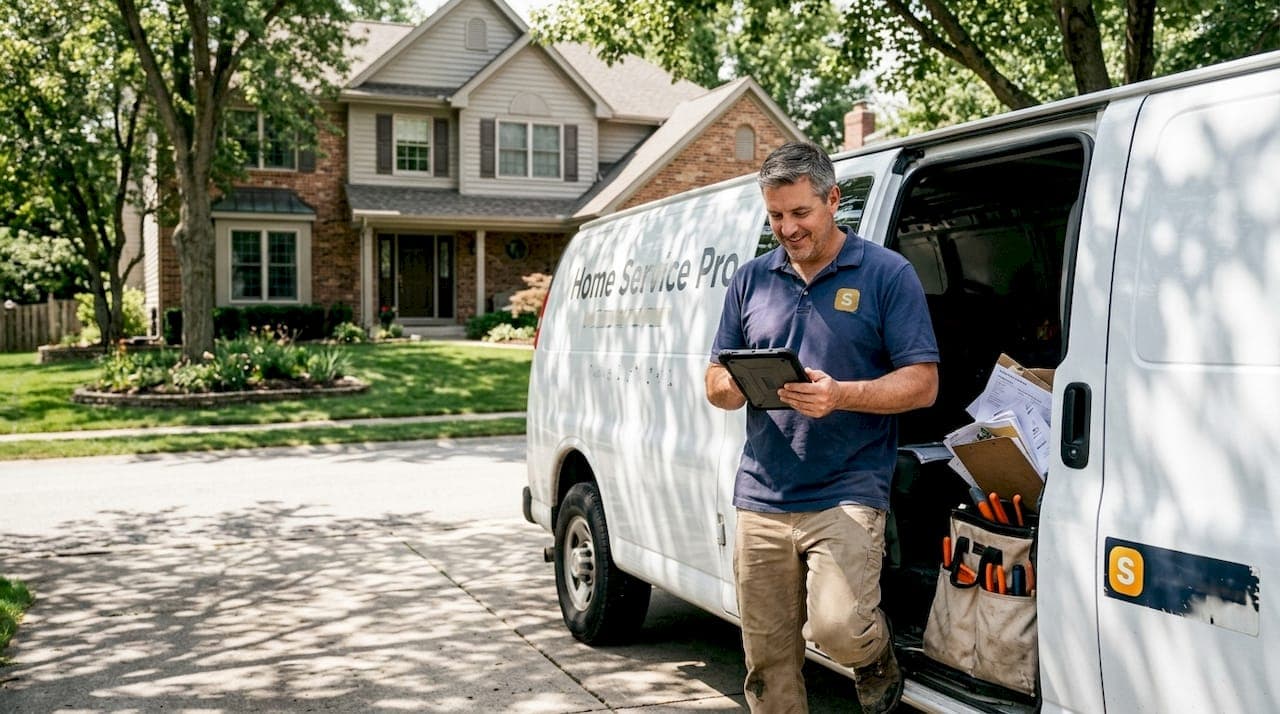
Fleet management sounds like something reserved for trucking companies or delivery giants. It is not. Any home service company with more than a handful of vehicles and technicians is, by definition, running a fleet. Whether it is a plumbing crew, an HVAC team, or a landscaping company, the way they manage their vehicles and people directly determines whether your appointment goes smoothly or falls apart.
At its core, fleet management means orchestrating vehicles, people, schedules, and data so that the right technician reaches the right home at the right time. The role of scheduling services in this process is enormous, because even a small scheduling error can ripple across an entire day of appointments.
The key mechanics of fleet management include:
- GPS vehicle tracking: Knowing exactly where every technician is at all times
- Route optimization: Calculating the fastest, most fuel-efficient paths between jobs
- Preventive maintenance (PM) scheduling: Keeping vehicles serviced before they break down
- Fuel management: Monitoring fuel use to control costs and flag inefficiencies
- Driver behavior monitoring: Tracking speed, braking, and idle time to reduce wear
- Compliance tracking: Ensuring vehicles and drivers meet all legal and safety standards
As Geotab explains, these core mechanics include vehicle tracking via GPS, route optimization, preventive maintenance scheduling, fuel management, driver behavior monitoring, and compliance tracking. When a provider has all of these working together, the result for you is fewer delays, more accurate arrival windows, and technicians who arrive prepared.
"The difference between a provider who shows up on time and one who keeps you waiting is rarely about individual effort. It is almost always about the systems running in the background."
For homeowners, this translates directly into less disruption. You are not burning a vacation day waiting for a no-show. You are not getting a last-minute call saying the truck broke down. A well-managed fleet is the foundation of a well-run service company, and understanding this gives you real power when choosing who to hire. The service management guide offers a broader look at how these systems connect to your overall home maintenance strategy.
How smart fleet management benefits homeowners
With the basics established, let's look at why homeowners should care about which providers use modern fleet management. The benefits are not abstract. They show up in your daily life in very specific ways.
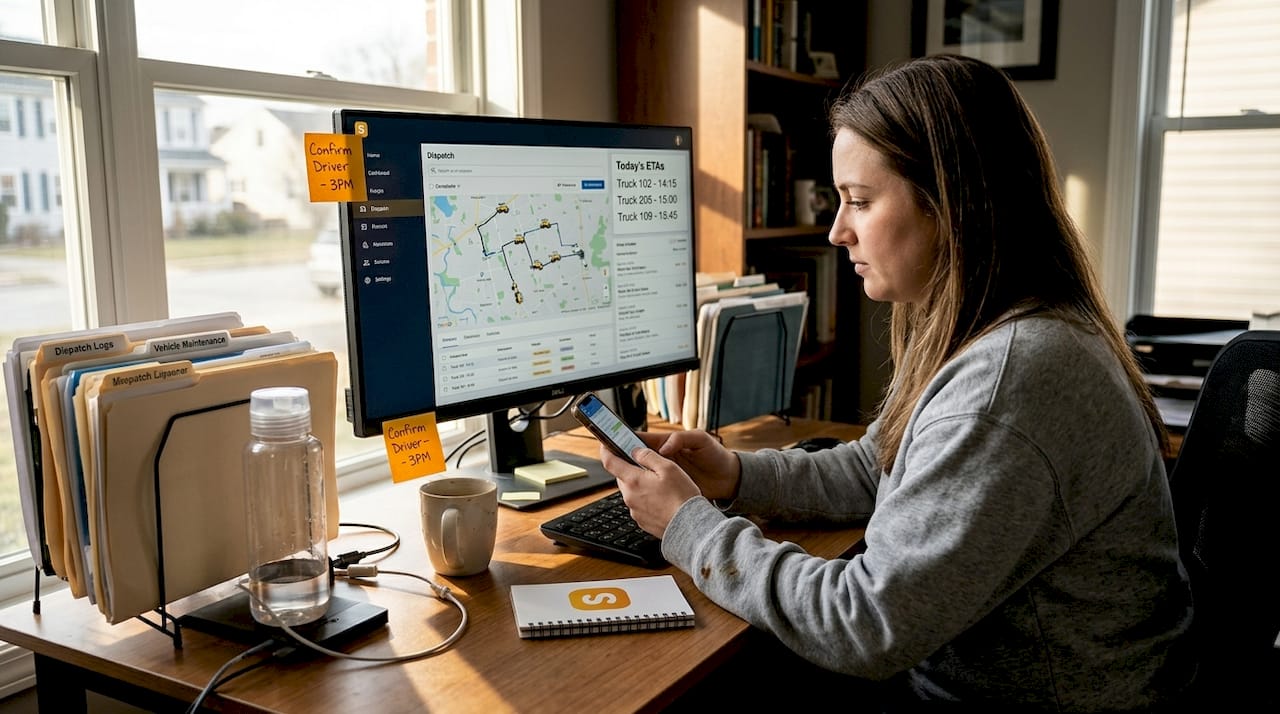
Providers using telematics (the technology that combines GPS with vehicle diagnostics) can give you real-time ETAs, reducing no-shows and last-minute cancellations. Preventive maintenance principles extend vehicle life, which means fewer breakdowns mid-route and fewer disruptions to your scheduled appointment.
Here is a side-by-side look at how the old and new approaches compare:
| Factor | Old approach | Modern fleet management |
|---|---|---|
| Arrival time | Estimated 4-hour window | 30-minute real-time window |
| Communication | Call if late (sometimes) | Automated updates via app |
| Breakdown risk | High, reactive repairs | Low, preventive scheduling |
| First-time fix rate | Inconsistent | 72% to 80% or higher |
| Scheduling flexibility | Paper-based, slow | Digital, instant rescheduling |
The steps a great provider takes to boost your experience typically look like this:
- Digitize dispatch: Use software to assign jobs based on technician location and skill
- Automate customer updates: Send real-time texts or app notifications as technicians travel
- Pre-load technician data: Ensure the tech knows your service history before arriving
- Track first-time fix rates: Monitor whether issues get resolved in one visit
- Review and improve: Analyze route and schedule data weekly to cut inefficiencies
For homeowners, simplifying service booking starts with choosing providers who have already done this work. You can also use apps for easy management to track your own appointments and hold providers accountable.
Pro Tip: Before booking any home service, ask the company directly: "What system do you use to track your technicians and minimize delays?" A confident, specific answer is a green flag. Vague answers are a warning sign.
Key metrics and benchmarks every homeowner should know
Understanding benefits is great, but savvy homeowners go further: they know how to measure provider quality using the right numbers. You do not need to become a fleet analyst. You just need to know which questions to ask and what good looks like.
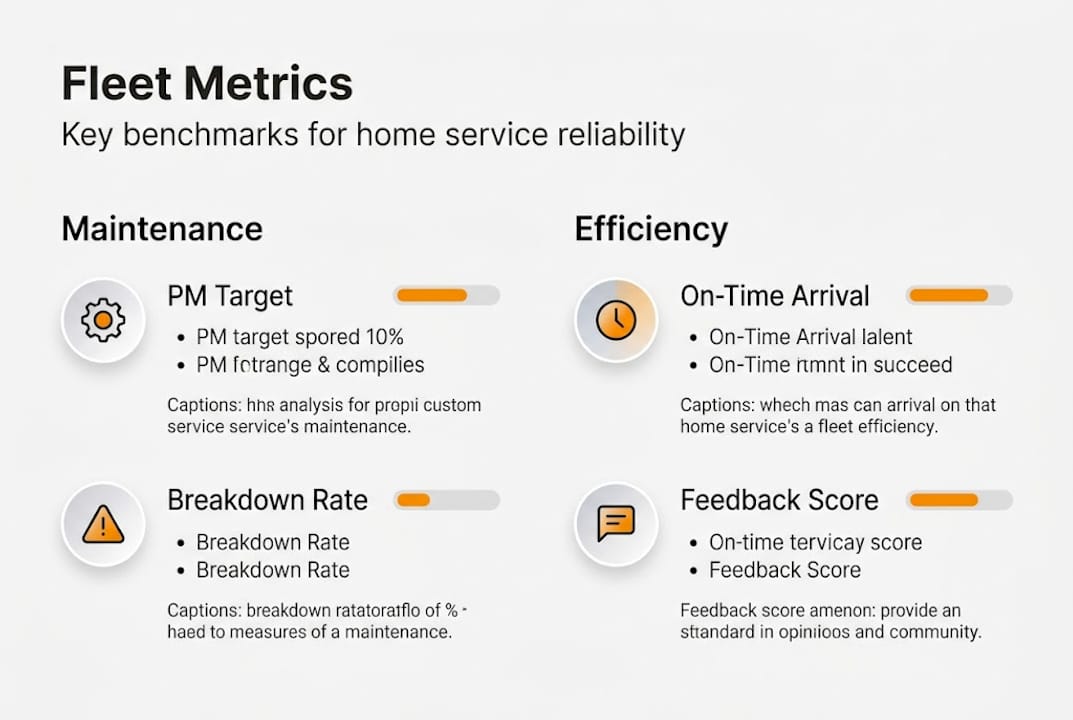
According to fleet maintenance automation research, the benchmarks that matter most are: PM compliance target of 95%, vehicle uptime above 95%, unplanned breakdowns reducible by 64% with automation, cost per mile between $0.08 and $0.14, and a first-time fix rate of 72% to 80% or higher.
Here is what those numbers mean for you as a homeowner:
| Metric | Benchmark target | What it means for you |
|---|---|---|
| PM compliance | 95%+ | Vehicles rarely break down mid-job |
| Vehicle uptime | 95%+ | Appointments rarely get canceled |
| Unplanned breakdowns | Reduced by 64% with automation | Fewer last-minute reschedules |
| First-time fix rate | 72% to 80%+ | Problems get solved in one visit |
| Cost per mile | $0.08 to $0.14 | Efficient operations, stable pricing |
Key metrics to ask about or look for in reviews:
- PM compliance rate: Does the company service its vehicles on schedule?
- Vehicle uptime percentage: How often are their trucks actually road-ready?
- First-time fix rate: Do technicians resolve the issue on the first visit?
- Response time to breakdowns: How fast do they recover when something goes wrong?
Automation is the game-changer here. Unplanned breakdowns drop by 64% when companies use automated maintenance scheduling instead of manual tracking. That is not a small improvement. It is the difference between a provider you can count on and one that keeps letting you down.
Using customer feedback for service quality is another smart way to gauge how well a provider's fleet operations actually perform in the real world. Reviews that mention on-time arrivals and first-visit fixes are strong signals of solid fleet practices. You can also look at how providers handle service project management to understand their overall operational discipline.
Common challenges and nuanced tradeoffs in fleet management
While data and benchmarks show what can work, let's not ignore the reality: fleet management for services has plenty of wrinkles and tough choices. Not every provider operates the same way, and some of the gaps in service quality come from structural challenges that are worth understanding.
Fleet management is not one-size-fits-all. 65% of small fleets are managed by a single person, which creates real overload risk. Seasonal demand spikes, like HVAC calls in peak summer, stretch even well-run operations thin. EV integration is adding new complexity as companies transition away from gas vehicles. And older vehicles (10 years or more) account for 34% of service spend, meaning aging fleets quietly drain resources that could go toward better customer experience.
Common tradeoffs providers face include:
- Software investment vs. cost control: Fleet management software reduces downtime by 30% to 35%, but smaller companies may hesitate on the upfront cost
- Proactive vs. reactive maintenance: Reactive repairs cost 3 to 9 times more than proactive ones, yet some providers still rely on fixing things after they break
- Buy vs. lease: Leasing offers flexibility for growing companies but can limit customization of vehicles for specialized services
- Spreadsheets vs. software: About 30% of fleets still use spreadsheets, which significantly increases the risk of missed maintenance and scheduling errors
"Proactive fleet management is not just an operational choice. It is a customer service choice. Every dollar saved on reactive repairs is a dollar that can go toward better technicians and faster response times."
For homeowners, this means setting service reminders for home upkeep is not just about your own schedule. It also helps you stay ahead of seasonal surges when provider capacity gets tight. Choosing providers on all-in-one service platforms gives you visibility into which companies are equipped to handle these challenges.
Pro Tip: When booking during peak seasons like summer AC calls or winter heating checks, ask providers how they handle demand surges and whether their fleet is up to date. A good answer shows operational maturity.
What most guides miss about fleet management for home services
Most articles about fleet management talk to business owners. We are talking to you, the homeowner, because that is where the real leverage lives. Here is the uncomfortable truth: most homeowners never ask about a provider's backend operations. They check reviews, maybe ask about pricing, and then hope for the best. That approach leaves a lot to chance.
Fleet mismanagement is one of the most underestimated drivers of unreliable home service. It is not always about a bad technician or a dishonest company. Sometimes it is simply a business running on outdated systems, overwhelmed dispatchers, or vehicles that should have been retired two years ago.
AI and predictive maintenance technology get a lot of attention right now, and they are genuinely promising. But the basics, GPS tracking, preventive maintenance, and real-time scheduling, still move the needle more than any cutting-edge tool. A company that has mastered the fundamentals will outperform one chasing the latest tech every time.
Our take: ask better questions. When you manage service appointments efficiently and hold providers to a higher standard, you push the entire industry to improve. Empowered homeowners drive better service outcomes, not just for themselves but for every neighbor on the block.
How to connect with reliable, modern home service providers
Ready to book your next home service with confidence? Here is how to make sure you choose a provider who will get it right from the start.

At Simple Service App, we built our platform specifically to take the guesswork out of this process. We connect you with vetted providers who use modern scheduling, real-time tracking, and proven fleet practices. You are not just booking a service. You are getting a consultant who negotiates, books, and manages everything on your behalf, all from one place. When you find modern home service providers through our network, you get the reliability that comes from providers who have already done the hard work of building smart operations. Save time, avoid surprises, and book with confidence.
Frequently asked questions
How does fleet management improve home service reliability?
It ensures on-time arrivals and fewer cancellations by optimizing routes, monitoring vehicles, and scheduling preventive maintenance. Providers using telematics for real-time ETAs consistently reduce no-shows and service disruptions.
What questions should homeowners ask about service providers' fleet management?
Ask if they use GPS tracking, real-time scheduling, and preventive maintenance tools to cut downtime and improve first-time fix rates. Providers with strong fleet management mechanics will answer confidently and specifically.
Why do some providers have late or canceled appointments despite using fleet management systems?
Challenges like supply chain delays, seasonal spikes, or older vehicles can disrupt even the best systems. Small fleets and seasonal demand are two of the most common culprits, so ask how providers plan for these situations.
How do I know if a service provider invests in preventive maintenance?
Look for a PM compliance rate of 95% or above, which is the standard benchmark for reducing breakdowns. Providers hitting automation-driven PM targets see up to 64% fewer unplanned breakdowns.