

TL;DR:
- Proper project management keeps home renovation projects on schedule and within budget.
- Digital tools help homeowners organize schedules, track costs, and communicate with contractors effectively.
- Having a dedicated project manager protects homeowners from delays, overspending, and common surprises.
Nearly half of all home renovation projects blow past their budget, and 85% exceed their timelines. Most homeowners assume that finding a skilled contractor is the hard part. Once that's done, they expect things to run smoothly. But the contractor's job is to build, not to manage your priorities, protect your budget, or keep every moving piece aligned. That's where project management comes in. Think of it as the operating system behind your renovation. This article walks you through what project management really means for home services, the steps that keep projects on track, the digital tools that make it easier, and how to handle the surprises that almost always show up.
Table of Contents
- What project management means for home services
- Essential steps in home project management
- Digital tools and software for organized renovations
- Handling common challenges and surprises
- Why 'just hiring a good contractor' isn't enough
- Streamline your next home project with smart management tools
- Frequently asked questions
Key Takeaways
| Point | Details |
|---|---|
| Project management benefits | It brings organization, reduces stress, and leads to more successful home services by keeping projects on track. |
| Essential planning steps | Proper scoping, budgeting with contingency, and clear task sequencing are crucial for managing home renovations efficiently. |
| Digital tool advantages | Modern apps offer transparency, help you manage timelines and spending, and simplify communication with contractors. |
| Handling surprises | Anticipating delays and unexpected issues keeps your project resilient and on target. |
What project management means for home services
Project management isn't just for corporate offices or construction firms. In the context of home services, it involves planning, budgeting, scheduling, coordinating contractors, risk management, and quality control. It's the full picture of getting from "I want to renovate my kitchen" to "the kitchen is done, on budget, and exactly how I wanted it."
Here's where a lot of homeowners get confused: a general contractor (GC) manages the build. A project manager (PM) manages the outcome. Those are two very different things. A GC coordinates their crew, orders materials, and executes the work. A PM, on the other hand, works for you. Their focus is on home maintenance scheduling, keeping costs in check, holding contractors accountable, and making sure your goals stay front and center throughout the project.
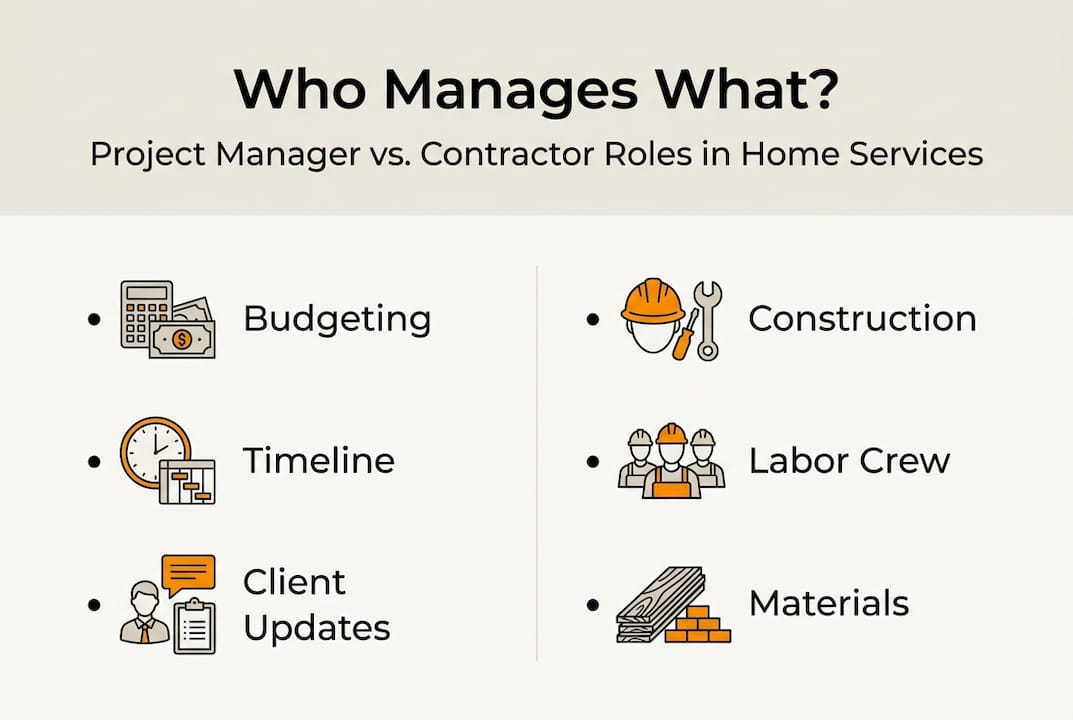
Think of it this way: the GC is the chef in the kitchen. The PM is the person who made the reservation, reviewed the menu in advance, confirmed dietary restrictions, and will make sure the bill matches what was agreed. Both matter. But without the PM role, you're just hoping things work out.
Here are the core benefits of applying real project management to your home services:
- Single point of contact: You get one person or system tracking everything, so nothing falls through the cracks.
- Accountability: Every contractor knows what's expected, when it's due, and what happens if they miss.
- Clarity: You always know where your money is going and what's happening on site.
- Stress reduction: You stop being the person chasing five different tradespeople for updates.
- Better outcomes: Projects finish closer to the original scope, timeline, and budget.
For a deeper look at what this looks like in practice, the practical service management guide breaks down how homeowners can apply these principles to everyday home services, not just big renovations.
"The homeowner's greatest advantage in any renovation is having someone whose only job is to protect their interests, not just complete the work." This is what separates a well-managed project from an expensive headache.
Project management shifts you from a passive payer to an informed decision-maker. That shift alone can save thousands of dollars and weeks of delays.
Essential steps in home project management
Knowing what project management is gives you the framework. Knowing the steps gives you the roadmap. Detailed planning, contingency budgeting, sequencing, and digital tools are the core methodologies that keep projects moving forward without costly detours.
Here's how a well-managed home project typically unfolds:
- Define the scope clearly. Write down exactly what you want done. Vague goals create vague results. If you want a bathroom remodel, specify tile type, fixture brands, and layout changes in writing.
- Set a realistic budget with a buffer. Build in a 15 to 20% contingency on top of your base estimate. Surprises aren't rare in home projects. They're almost guaranteed.
- Sequence your tasks. Electrical before drywall. Plumbing before flooring. Getting the order wrong means tearing apart finished work, which costs double.
- Vet and schedule contractors in advance. Don't wait until one trade finishes to call the next. Overlap scheduling so there's no dead time.
- Run weekly check-ins. A quick 15-minute review of what's done, what's next, and what's blocked keeps everyone aligned and problems small.
- Document everything. Change orders, receipts, photos of work in progress. If a dispute arises, your records are your protection.
Pro Tip: Scope creep is the silent budget killer. Every time you say "while they're here, let's also add..." without a formal change order and updated budget, you're adding risk. Treat every addition like a new mini-project with its own cost and timeline approval.
| Factor | With project management | Without project management |
|---|---|---|
| Budget accuracy | Within 10 to 15% of estimate | Often 30 to 50% over |
| Timeline adherence | Mostly on schedule | Delays common |
| Contractor accountability | Documented and enforced | Informal and inconsistent |
| Stress level | Manageable | High |
| Dispute resolution | Faster, documented | Difficult, often costly |
For more on streamlining home repairs and building a smoother service booking workflow, these resources walk through the practical side of keeping your home projects organized from start to finish.
Digital tools and software for organized renovations
Best practices create the structure. The right digital tools make that structure visible and manageable, especially when you're juggling multiple contractors, timelines, and invoices at once.

Software like Asana, Trello, Buildertrend, Homellow, and Homer offer task tracking, budget monitoring, and contractor communication in one place. They reduce the back-and-forth of texts and emails that usually get lost, and they give you a real-time picture of where your project stands.
Here's a quick comparison of popular options:
| Tool | Best for | Key features | Cost |
|---|---|---|---|
| Buildertrend | Larger renovations | Scheduling, budgeting, client portal | Paid |
| Asana | Task-focused projects | Task lists, timelines, team collaboration | Free/Paid |
| Homellow | Home maintenance tracking | Maintenance logs, reminders, costs | Free |
| Homer | All-in-one home management | Document storage, contractor contacts, budgets | Free/Paid |
Each tool has a different strength. Buildertrend is built for contractors but works well for homeowners managing large jobs. Asana is flexible and great if you're comfortable with task management software. Homellow and Homer are designed specifically for homeowners, making them more intuitive for people who aren't project managers by trade.
Here's what digital tools actually help you do:
- Track real costs vs. estimates in real time, so you catch overruns early.
- Store all contractor communications in one searchable place.
- Set automated reminders for inspections, payments, and follow-ups.
- Share project status with family members or co-owners without extra calls.
Pro Tip: Match the tool to your project size. A bathroom refresh doesn't need Buildertrend. A simple shared checklist in Homellow or even a Google Sheet works fine. Save the heavy software for full-scale renovations where you're managing three or more contractors simultaneously.
For homeowners who want to build smart routines for homes or get ahead with annual maintenance scheduling, pairing the right digital tool with a solid routine makes a measurable difference in how smoothly your home runs year-round.
Handling common challenges and surprises
Even the best-planned projects hit walls. Literally and figuratively. The question isn't whether surprises will happen. It's whether you're set up to handle them without derailing the whole project.
Common challenges homeowners face include:
- Permitting delays: Permits can take weeks longer than expected. Always apply early and build permit timelines into your schedule.
- Supply chain issues: Materials get backordered. Order key items as early as possible, especially custom fixtures or specialty tile.
- Hidden structural problems: Opening a wall and finding water damage or outdated wiring is more common than most people expect. Your contingency budget exists for exactly this.
- HOA or neighbor conflicts: Noise ordinances, shared walls, and property line questions can pause work. Know your local rules before you start.
- Contractor no-shows or scheduling gaps: When one trade finishes early or late, it creates a domino effect. Good service appointments management helps you adjust quickly.
The data on DIY approaches is worth noting. A significant share of homeowners who go the DIY route without proper planning end up regretting it, with many needing professional fixes after the fact. Permitting delays, supply chain issues, and unexpected problems are the most cited culprits when projects go sideways.
"A project manager doesn't prevent every problem. They make sure problems get solved before they become disasters. That's the difference between a two-day delay and a two-month one."
Staying ahead of these issues means keeping a live maintenance checklist and setting service reminders so nothing gets forgotten between contractor visits. Proactive homeowners spend less time reacting and more time enjoying the results.
Why 'just hiring a good contractor' isn't enough
Here's the uncomfortable truth most renovation articles skip: a great contractor does not automatically equal a great project outcome. Contractors are skilled at their trade. They are not always skilled at communication, schedule coordination, or keeping your budget as their top priority. That's not a criticism. It's just a different job.
When there's no project manager in the picture, the homeowner becomes the de facto PM by default, usually without the tools, experience, or time to do it well. Miscommunication between trades, unclear change orders, and missed deadlines pile up quietly until they become expensive problems.
The overlooked benefit of proper project management is what happens after the project ends. Organized records, documented warranties, and a clear history of what was done and when make future maintenance and resale conversations dramatically easier. That's long-term value most homeowners never think about at the start.
Before signing any contract, ask these questions: Who is responsible for coordinating between trades? What happens if a deadline is missed? How are change orders handled and approved? If you don't have clear answers, you need a PM in the mix. For more on how professional guidance changes the equation, the home services consulting resource explains what that support actually looks like for homeowners.
Streamline your next home project with smart management tools
If reading this made you realize your last project could have gone smoother, you're not alone. Most homeowners learn project management the hard way, one overrun budget at a time. But it doesn't have to work that way.

At The Simple Service App, we act as your personal home agent. Our network of contracting consultants handles the negotiating, booking, and managing of your home services, all from one place. You get transparent pricing, organized scheduling, and a single point of contact for everything your home needs. No chasing contractors. No surprise invoices. Just a smoother, more organized way to take care of your home. Explore how we can support your next project today.
Frequently asked questions
How does project management save money on home renovations?
Good project management reduces delays by 40% and keeps budgets on track through clear planning, contingency buffers, and consistent oversight of materials and deadlines. Without it, nearly half of all renovation projects end up over budget.
What digital tools are recommended for managing home service projects?
Buildertrend, Asana, Homellow, and Homer are popular options that help homeowners track schedules, monitor budgets, and keep contractor communication organized in one place.
What are the biggest risks to home projects without proper management?
Without oversight, projects frequently face budget overruns and timeline failures, with 85% of renovations running past their deadline and 47% exceeding their original budget. Unresolved contractor disputes and compliance gaps are also common.
Is the homeowner or the contractor responsible for project management?
A project manager acts as the homeowner's advocate, focusing on oversight rather than construction. Homeowners should stay actively informed, but the PM role is specifically designed to protect their interests throughout the project.