

Americans spend 1.6 to 1.87 hours daily on household activities, which adds up to nearly 13 hours every single week. That's time you could spend with family, on hobbies, or simply resting. The good news is that most of that effort is disorganized, repeated, and ripe for cutting down. This guide walks you through a proven four-step process to assess, prepare, execute, and maintain a streamlined home management system that actually sticks.
Table of Contents
- Assess your household tasks and pain points
- Prepare: Gather tools, resources, and a smart checklist system
- Execute: Streamlined routines for cleaning, maintenance, and decluttering
- Adjust and troubleshoot: Customization and solving common challenges
- Verify and maintain: Long-term consistency and easy wins
- Ready for even simpler home management?
- Frequently asked questions
Key Takeaways
| Point | Details |
|---|---|
| Batch and automate tasks | Grouping similar chores and using technology reduces repeat effort. |
| Declutter strategically | Start small and use proven methods like the 4-Box system for lasting results. |
| Customize your approach | Adapt checklists and routines for your region, family size, and home layout. |
| Leverage daily resets | Short, consistent maintenance blocks prevent overwhelming messes. |
| Track and refine | Monitor progress to stay on top of tasks and improve your system over time. |
Assess your household tasks and pain points
Before you can fix anything, you need to know exactly where your time is going. Most homeowners have a vague sense that chores take forever, but they rarely pinpoint which ones are the real culprits.
The kitchen is a major offender. It consumes 40% of cleaning time, with daily cleaning averaging 0.36 to 0.49 hours on its own. Bathrooms, laundry, and general tidying follow close behind. When you know which rooms drain your energy most, you can target them first.
Here are the most common time-consuming household tasks for American homeowners:
- Kitchen cleaning and dishes (daily, high frequency)
- Laundry (washing, drying, folding, and putting away)
- Vacuuming and floor care (weekly or more)
- Bathroom scrubbing (weekly)
- Decluttering and tidying common areas (ongoing)
- Yard work and outdoor maintenance (seasonal)
- Home maintenance checks (monthly or seasonal)
| Task | Average time per week | Frustration level |
|---|---|---|
| Kitchen cleaning | 3.5 hours | High |
| Laundry (full cycle) | 2.5 hours | Medium |
| Vacuuming and floors | 1.5 hours | Medium |
| Bathroom cleaning | 1 hour | High |
| Decluttering | 1 hour | Very high |
| Outdoor maintenance | 2 hours | Medium |
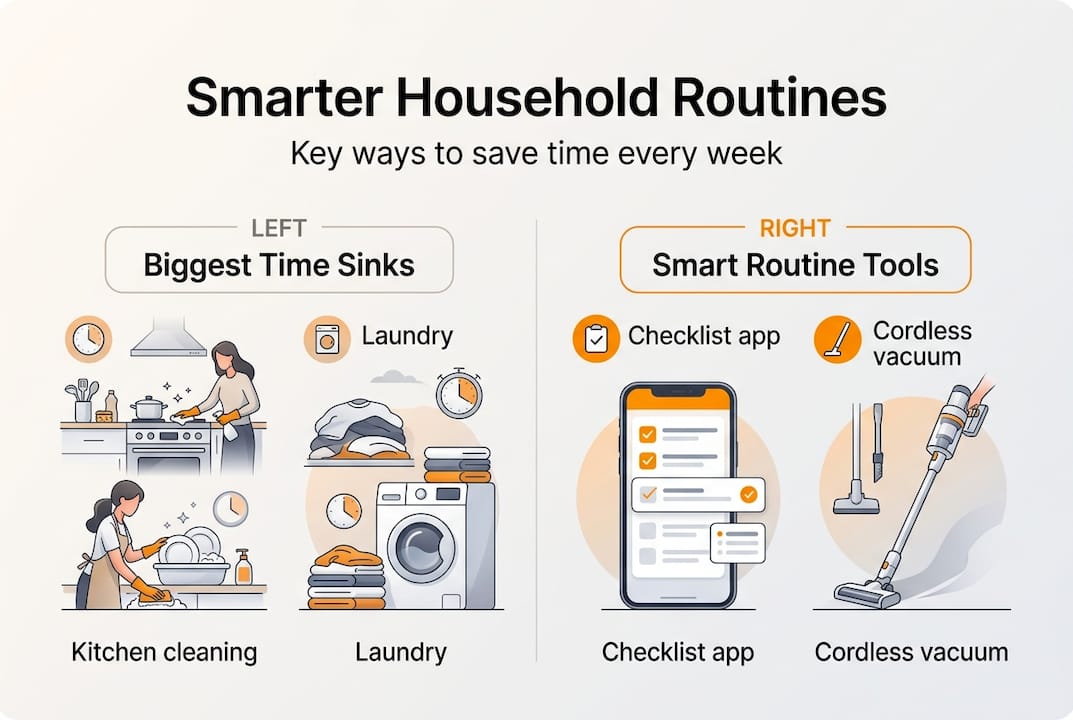
Once you see the data laid out, the path forward gets clearer. A weekly reset routine can bring your total cleaning time down to just 2 to 2.5 hours per week. That's a dramatic shift from the national average. Pairing this with organizing your space strategically makes every task faster from the start.
Prepare: Gather tools, resources, and a smart checklist system
Identifying your problem areas lets you equip yourself efficiently for daily management. The right tools and systems make the difference between a routine that lasts and one that falls apart by week two.
Start with the physical basics. A good microfiber mop, a cordless vacuum, an all-purpose cleaner, and labeled storage bins will handle 80% of your daily needs. Don't overbuy. More supplies often means more clutter, not more efficiency.
Next, build your checklist system. Seasonal and monthly checklists are proven to prevent costly home issues before they start. Think of it like a car service schedule: you don't wait for the engine light to change the oil. The same logic applies to your gutters, HVAC filters, and smoke detectors.
| Checklist type | Best for | Format |
|---|---|---|
| Daily checklist | Quick resets and tidying | Paper or phone note |
| Weekly checklist | Cleaning zones and laundry | App or printed sheet |
| Monthly checklist | Maintenance tasks and inspections | Digital app |
| Seasonal checklist | HVAC, gutters, weatherproofing | Shared family app |
For digital tools, home management apps like Homer automate reminders, track inventory, and schedule recurring tasks so nothing slips through the cracks. If you want a broader view of planning ahead, check out annual home maintenance scheduling and a ready-to-use spring cleaning checklist to get started fast.

Pro Tip: Set up your checklist app on Sunday evening. Spend five minutes reviewing the week ahead so Monday morning never catches you off guard.
Execute: Streamlined routines for cleaning, maintenance, and decluttering
With tools and checklists ready, it's time to put streamlined routines into action for daily, weekly, and monthly success. This is where most homeowners either win big or fall back into old habits.
The secret is batching and time-blocking. Instead of cleaning a little every day with no structure, assign specific tasks to specific days. Here's a simple weekly framework:
- Monday: Laundry start and kitchen deep wipe-down (20 minutes)
- Tuesday: Bathrooms and mirrors (15 minutes)
- Wednesday: Vacuuming all floors (20 minutes)
- Thursday: Dusting surfaces and tidying common areas (15 minutes)
- Friday: Mop floors and take out trash (15 minutes)
- Saturday: Outdoor tasks and yard check (30 minutes)
- Sunday: Weekly reset and checklist review (10 minutes)
A daily 10 to 15 minute maintenance habit prevents the need for exhausting deep cleans. Think of it as paying a small daily fee instead of a massive bill at the end of the month.
Technology helps too. Robot vacuums appear in 30.4% of busy US homes, and for good reason. They handle floors while you do something else entirely. Pair that with smart timers on dishwashers and washing machines, and you're running a household on autopilot.
For decluttering, the 4-Box method works room by room: keep, donate, trash, and relocate. Follow it with the one-in-one-out rule, meaning every new item that enters your home means one leaves. This prevents clutter from creeping back.
Statistic: Homes that use batching and zone-based cleaning spend up to 40% less time on weekly chores compared to homes with no structured routine.
For more ideas on staying organized, explore these organizing tips and learn how scheduling household tasks consistently leads to fewer surprises. If you want everything in one place, all-in-one management platforms are worth a serious look.
Pro Tip: Set a visible kitchen timer when you start a cleaning task. Knowing there's an endpoint makes it far easier to start, and most tasks finish faster than you expect.
Adjust and troubleshoot: Customization and solving common challenges
Even with the best routines, real homes throw curveballs. Here's how to stay on track when challenges arise.
Regional factors matter more than most guides admit. Homeowners in freeze-thaw climates need to check pipe insulation and roof drainage every fall. Those in wildfire zones or freeze-thaw regions face unique seasonal demands that a generic checklist simply won't cover. Customize your routine to match your zip code, not just your floor plan.
Knowing when to call a pro is just as important as knowing what to DIY. Routine tasks like cleaning, organizing, and basic yard work are perfect for self-management. But HVAC servicing, electrical work, and structural repairs are areas where professional help pays for itself in safety and long-term savings.
Common pitfalls that derail even motivated homeowners:
- Procrastinating on resets: Skipping one weekly reset makes the next one twice as hard.
- Overbuying storage: More bins don't fix clutter. Declutter before buying organizers, or you're just hiding the problem.
- Ignoring seasonal shifts: Your summer routine won't work in winter. Build in a seasonal review every three months.
- Skipping maintenance reminders: Setting service reminders for upkeep is one of the simplest ways to avoid expensive emergency repairs.
"Clutter is not just physical stuff. It's old ideas, toxic relationships, and bad habits." The same applies to outdated home routines that no longer serve your lifestyle.
Pro Tip: Every three months, spend 20 minutes reviewing your checklist system. Remove tasks that no longer apply and add anything new your home needs. Treat it like a quarterly performance review for your house.
Verify and maintain: Long-term consistency and easy wins
The final step is ensuring your new streamlined approach continues to work and delivers more time and peace each season. Routines only stick when you build in checkpoints.
Here's how to verify your system is working:
- Week 1 to 2: Notice if daily resets feel manageable. If they take more than 20 minutes, simplify the task list.
- Month 1: Check whether deep cleans are becoming less frequent. That's a clear sign your daily habits are working.
- Month 3: Review your checklist for seasonal updates. Add or remove tasks based on what's actually happening in your home.
- Month 6: Assess your overall stress level around home management. If it's lower, your system is doing its job.
15-minute daily resets prevent 80% of recluttering from happening in the first place. That single habit is the backbone of every successful long-term home management system.
| Signal | What it means | Action |
|---|---|---|
| Deep cleans less frequent | Daily habits are working | Keep going, refine slightly |
| Clutter returning fast | One-in-one-out rule slipping | Recommit to the rule daily |
| Checklist feels overwhelming | Too many tasks at once | Cut list by 30%, prioritize top 5 |
| Maintenance issues piling up | Seasonal review was skipped | Schedule a catch-up weekend |
| Stress around chores is low | System is working well | Share it with your household |
For an even smoother experience, look into streamlining your booking workflow for professional services so that when you do need outside help, it's fast and painless.
Ready for even simpler home management?
You've built the foundation: a clear assessment, the right tools, a working routine, and a system for staying on track. The next level is letting technology handle the parts that still require manual effort.

The Simple Service App acts as your personal home agent, handling the negotiation, booking, and management of home services all from one place. No more juggling multiple contractors or losing track of who's coming when. If you're also curious about what else is out there, we've compared other home management apps so you can make the best choice for your household. The goal is simple: less time managing your home, more time enjoying it.
Frequently asked questions
What is the fastest way to reduce time spent on household chores?
Batching similar tasks and using daily 10 to 15 minute resets can bring your total weekly cleaning time down to just 2 to 2.5 hours. Consistency matters more than intensity.
How often should I update my home maintenance checklist?
Review and update your checklist seasonally and monthly. Seasonal and monthly checklists are the most reliable way to catch problems before they become expensive repairs.
Do home management apps really save time?
Yes. Apps like Homer provide AI reminders, inventory tracking, and task scheduling so you spend less mental energy remembering what needs to get done.
What if my clutter keeps returning?
Stick with the one-in-one-out rule and build in 15-minute daily resets. Without maintenance, 80% of clutter returns within six months of a big declutter session.
How do I know if I should hire a pro or do it myself?
Routine cleaning and organizing are great for DIY. For technical or safety-related work in wildfire zones or freeze-thaw climates, a licensed professional is the smarter and safer call.